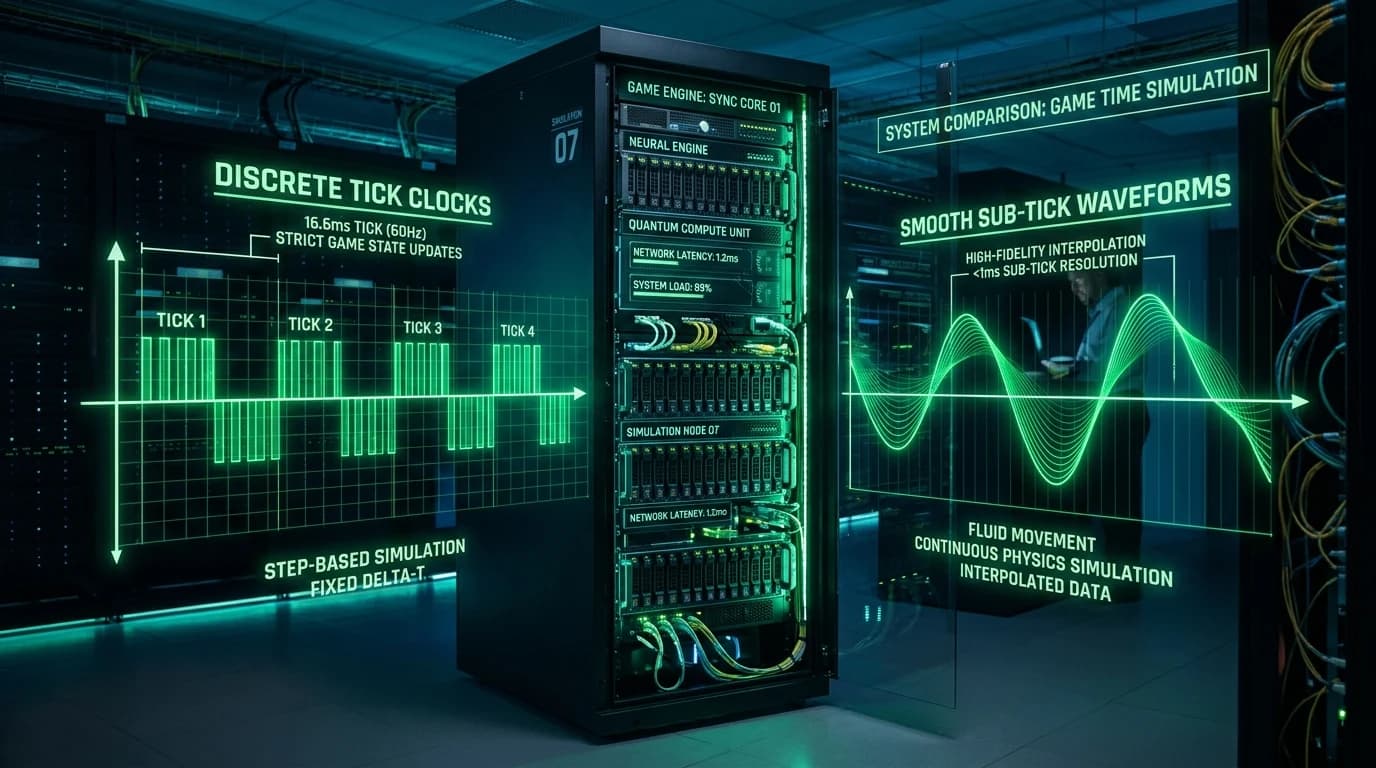
The Decades-Long Evolution of Server Tick Rates
From the original Quake World to CS:GO 128-tick, multiplayer physics simulations relied on fixed interval loops. However, competitive gaming in 2026 is moving toward continuous temporal precision via Valve Sub-Tick (Source 2) and continuous Tickless Event Streams (Unreal Engine 5 Replication Graph).
Sub-Tick vs Fixed Tick vs Tickless: The Differences
| Network Model | Input Registration | Bandwidth Demand |
|---|---|---|
| Fixed 64/128-Tick | Snapped to next tick boundary | Static packet rate (~128 pkts/sec) |
| Valve Sub-Tick | Exact fractional millisecond timestamp | Dynamic variable packet payload |
| Pure Tickless (Sim) | Continuous event-driven delta sync | High bandwidth requirement |
Clock Drift & Timestamp Validation
To prevent malicious clients from manipulating timestamps (speed hacking or backdating shots), game servers continuously measure Round Trip Time (RTT) and reject inputs with timestamps falling outside acceptable client-server clock drift tolerances.
Read our technical breakdown on CS2 sub-tick packet loss diagnostics.
Audit your connection latency and check your ISP routing on our free online network inspector.