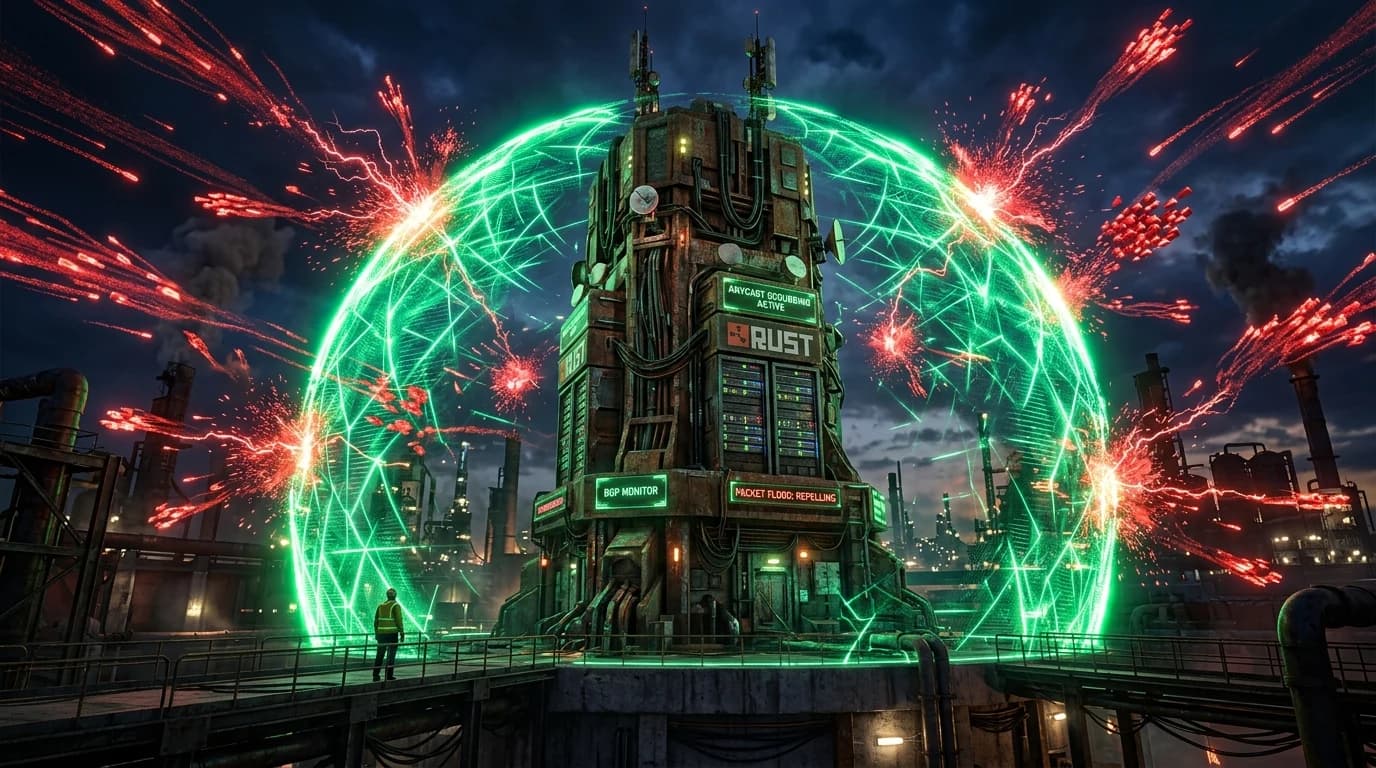
The Fierce Arena of Rust Wipe Day Hosting
In Rust, server wipe days represent intense financial competition. Large community networks (Vital, Rustoria, Moose) host 500-player queues with thousands of dollars in VIP queue-skip sales. Consequently, rival server operators and disgruntled clans launch massive 100Gbps+ Distributed Denial of Service (DDoS) Attacks on wipe hour.
Anatomy of a Rust Server Flood
Rust relies on the RakNet UDP protocol for real-time game world synchronization:
- RakNet Connect Floods: Attackers send millions of forged connection handshake packets (
ID_OPEN_CONNECTION_REQUEST_1) with randomized IP headers, filling the server connection slot queue. - UDP Fragment Amplification: NTP and DNS reflector botnets flood the server game port (e.g.,
28015), saturating upstream datacenter transit pipes. - A2S_INFO Query Exhaustion: Querying the Steam server browser endpoint at 100,000 requests/second locks the server main thread, making it appear offline in the server list.
Deploying Enterprise BGP Scrubbing Defenses
- BGP Anycast Filtering: Route server IP blocks through specialized gaming anti-DDoS scrubbing providers (Path.net, Cosmic Guard, OVH Game).
- RakNet State Validation at the Edge: Edge scrubbing nodes drop malformed UDP packets before they reach the game host machine.
- Cache Steam A2S Queries: Use caching proxies to answer Steam server browser queries without touching the main Rust server process.
Read our guide on Rust server RCON port hardening and firewall rules.
Audit your server connection latency on our free online IP scanner.