The Deep Firmware Layer: ACPI Tables Explained
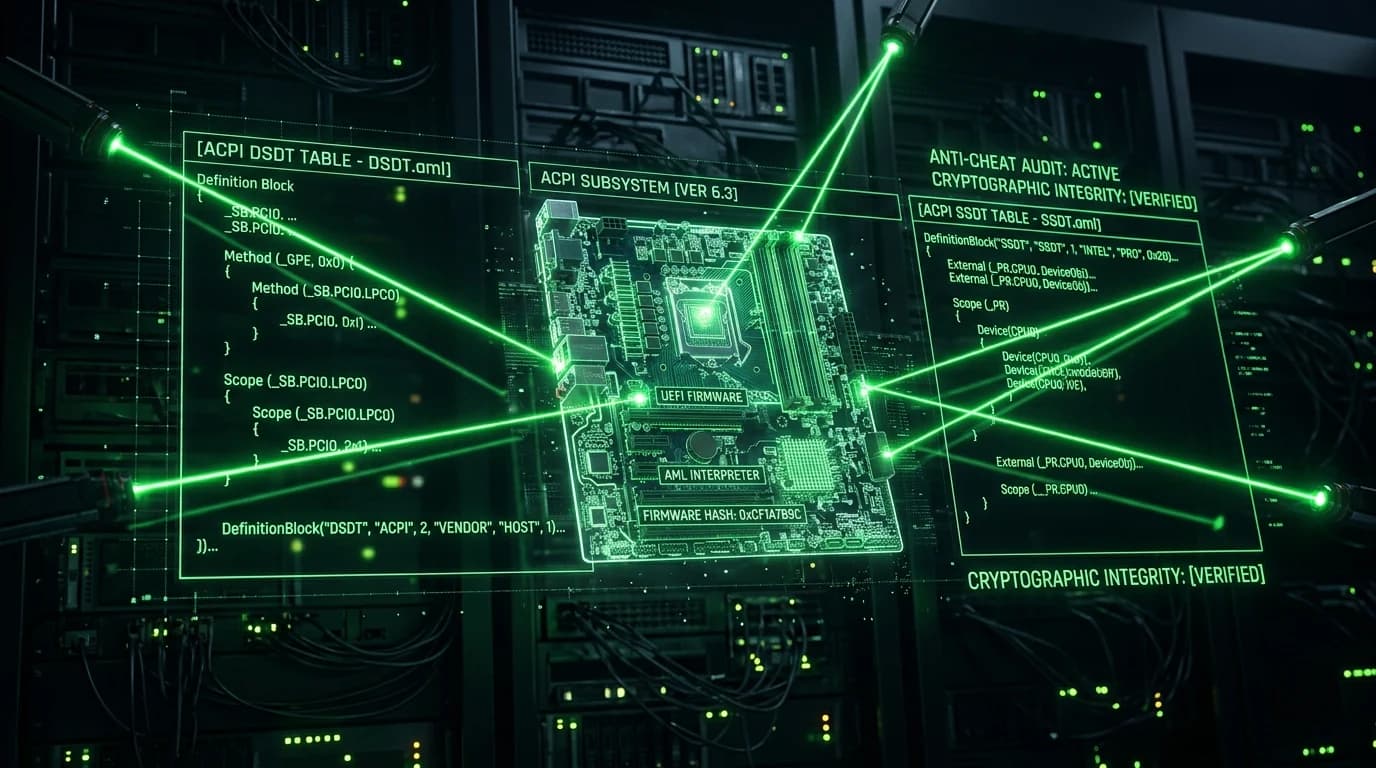
The Advanced Configuration and Power Interface (ACPI) is an open industry standard that allows the operating system to discover and configure computer hardware components. Motherboard firmware exposes compiled AML (ACPI Machine Language) bytecodes through tables such as the DSDT (Differentiated System Description Table) and SSDT (Secondary System Description Table).
How Kernel Anti-Cheats Parse ACPI Tables
When investigating potential hardware bans or hypervisor tampering, kernel anti-cheats (Riot Vanguard, Easy Anti-Cheat) inspect the physical memory pages containing ACPI headers:
| ACPI Header Field | Expected OEM Data | Tampering Anomaly Detected |
|---|---|---|
| OEMID | Valid vendor string (e.g., "ASUS ", "ALASKA") | Generic strings or mismatched byte padding |
| OEM Table ID | Specific motherboard chipset code | Emulated QEMU/KVM identifiers (e.g., "BOCHS ") |
| Table Checksum | Byte sum modulo 256 equals 0 | Non-zero checksum indicating memory modification |
Why Modifying ACPI Memory Triggers Instant Bans
Spoofers attempting to hook \Device\PhysicalMemory or patch ACPI tables in kernel memory fail because Windows PatchGuard (KPP) and anti-cheat checksum routines continuously re-verify table hashes against original UEFI memory maps.
Read our technical breakdown on SMBIOS Type 1, 2, and 3 table fingerprinting.
Audit your system network profile on the DCIPCHECK Pro cybersecurity suite.