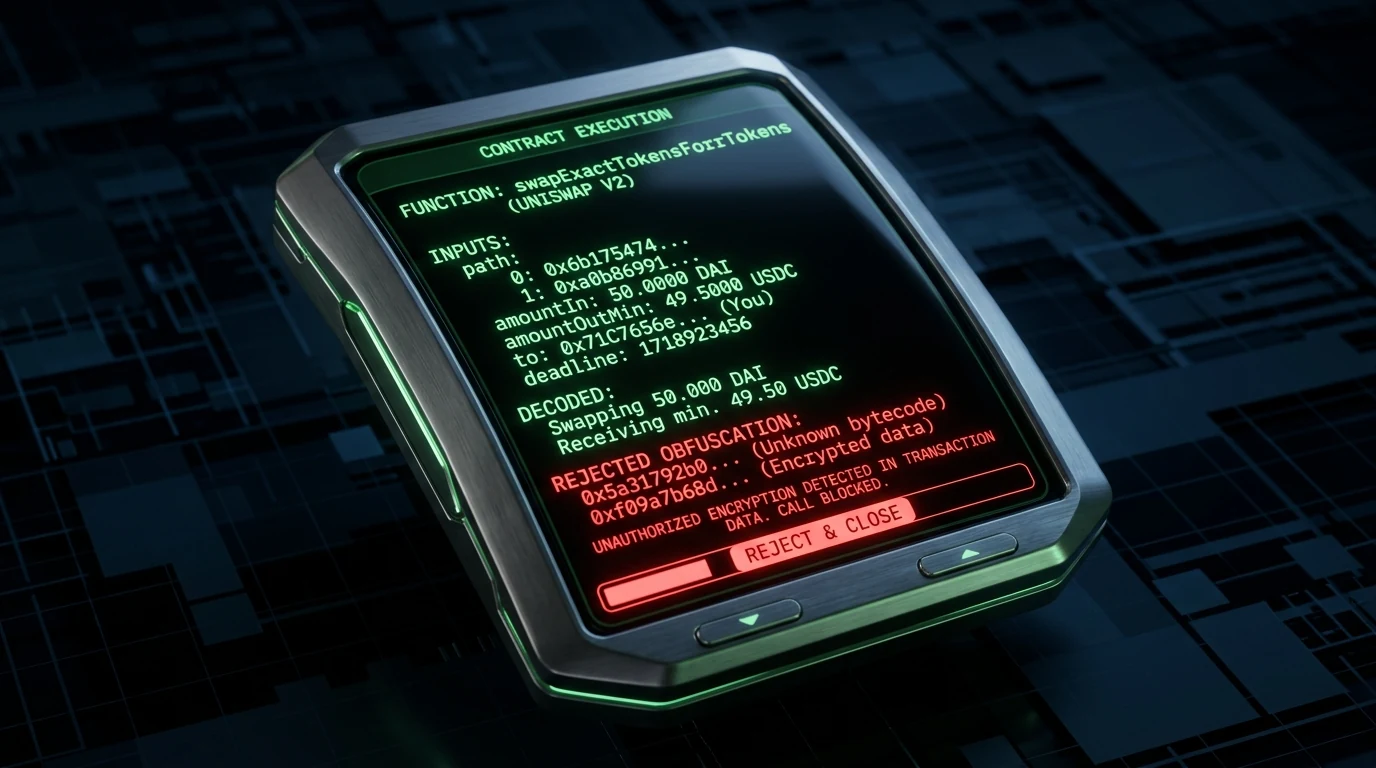
The Danger of Signing What You Cannot Read
When interacting with complex decentralized finance (DeFi) smart contracts, hardware wallet screens historically displayed unparsed raw hex data (e.g., Data: 0x095ea7b3000...), requiring users to enable "Blind Signing" in device settings. Cybercriminals exploited this blind trust to steal millions.
The Phishing Exploit: Masked Contract Approvals
Under Blind Signing, a phishing website presents a fake "Mint Free NFT" button on your desktop screen, but sends a raw hexadecimal smart contract call to your hardware wallet that executes an unlimited ERC-20 token approval to the drainer contract.
How "Clear Signing" Restores Cryptographic Security
Hardware wallet manufacturers (Ledger, Trezor, Keystone) developed Clear Signing Standards (ERC-7730):
- On-Device Contract Parsing: The hardware wallet firmware securely parses smart contract ABIs directly on the physical OLED screen.
- Explicit Human-Readable Displays: Instead of raw hex hashes, the device displays: "Swap 50 DAI for 49.50 USDC on Uniswap V2" or "Grant Unlimited Spending Allowance of USDT to Address 0x123...".
- Rejecting Obfuscated Calls: If a contract call cannot be fully decoded into human-readable parameters, the hardware wallet displays a prominent warning prompt urging the user to reject the transaction.
Read our investigation on Permit2 and eth_sign signature poisoning exploits.
Verify your connection security and audit your active network routing on our free Web3 network inspector.