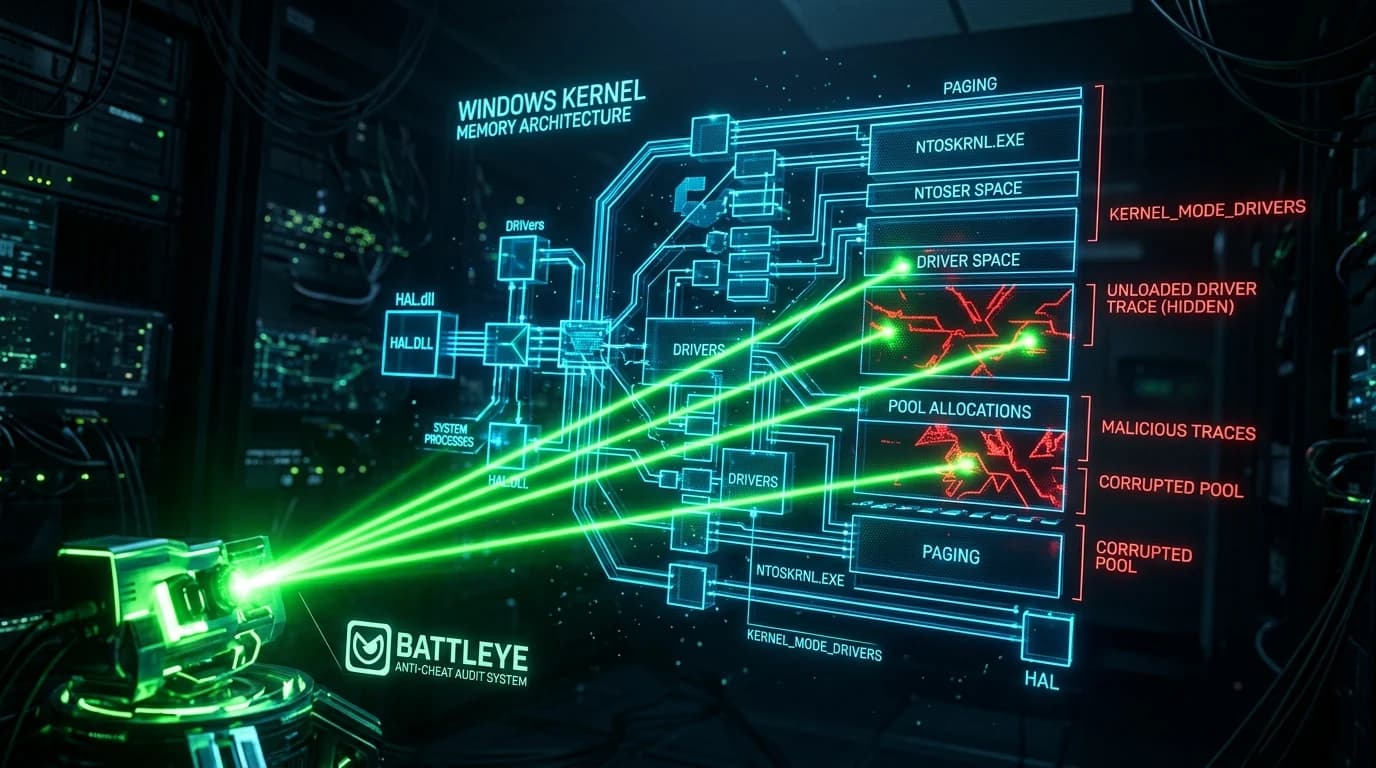
The Myth of the "Cleanly Unloaded" Kernel Driver
To bypass Windows Driver Signature Enforcement (DSE), cheat authors frequently use tools like KDU (Kernel Driver Utility) to load a vulnerable signed third-party driver (e.g., an outdated Gigabyte or Capcom driver), execute an arbitrary kernel write, and immediately unload the driver. They believe leaving no active driver makes them invisible. They are wrong.
How BattlEye Forensically Identifies Unloaded Drivers
The Windows kernel maintains internal diagnostic structures that anti-cheat drivers actively inspect:
- The
MmUnloadedDriversCircular Array: Windows keeps a circular list of the last 50 unloaded drivers, including module names, start/end memory addresses, and unload timestamps. If BattlEye spots a known vulnerable driver (e.g.,gdrv.sys), it triggers an automated ban flag. - Clearing
MmUnloadedDriversCreates an Anomaly: If a cheat wipes this array, BattlEye detects that legitimate system drivers (like printer or graphics miniports) are missing from the log, flagging an impossible memory state. - Orphaned Kernel Thread Call Stacks: If a thread created by the cheat is executing code in non-backed physical memory (RAM with no corresponding
.sysfile on disk), stack walking algorithms catch it instantly.
The Reality of Ring-0 Detection
Modern anti-cheats do not merely search for running processes; they audit the entire historical memory lifecycle of the Windows operating system. Read our analysis on Vanguard kernel thread callbacks and driver scans.
Check your public connection profile on our free online IP lookup tool.